Author Archives: Michelle Sadler

Unknown's avatar

About Michelle Sadler

Writer, reader, library professional, garden designer, bumble bee advocate. Mother of two boys, two Kelpies and 20 chickens. Lives in country Victoria, west of Melbourne.

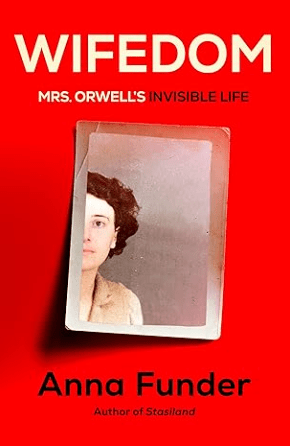
There is much to be done to extract women from the shadows of a history recorded by men. Anna Funder has certainly contributed to that endeavour with her fourth offering, ‘Wifedom: Mrs Orwell’s Invisable Life’ (2023).

The tenacity and effort it takes to erase women from the narrative is brought to bear by Funder, and it is evident she has taken great skill and care to undo what was done to Eileen Blair. The book is comprised of many short and sharp chapters spanning 400 pages, followed by 50 pages of footnotes. The chapters range from biography, memoir, the writing manifesto, and feminist commentary. The story that unfolds is a page-turner. It is intelligent, entertaining, informative, frustrating, and belongs on every person’s shelf who is interested in wading through the muck of patriarchy to get a little closer to a History, yes, the one with a capital H, where women can exist.

The book is a record of a life that was deliberately undermined by the husband when it was lived and ignored ever since by the ten male biographers of the husband that have come after. It is also aiming a beacon at the insidious nature of patriarchy and misogyny, dished out by a man who is, and rightly so, known for calling out classism and political ideologies that seek to oppress. Funder looks critically at the contrasts. By cleaning up the context where several great works were written, Funder unashamedly laments the character of the man who wrote them. Wifedom is a book that will appear on the curriculum in no time at all.

On resilience…

Aldous Huxley, from Island (1962)

It’s dark because you are trying too hard.
Lightly child, lightly. Learn to do everything lightly.
Yes, feel lightly even though you’re feeling deeply.
Just lightly let things happen and lightly cope with them.

I was so preposterously serious in those days, such a humorless little prig.
Lightly, lightly – it’s the best advice ever given me.
When it comes to dying even. Nothing ponderous, or portentous, or emphatic.
No rhetoric, no tremolos,
no self conscious persona putting on its celebrated imitation of Christ or Little Nell.
And of course, no theology, no metaphysics.
Just the fact of dying and the fact of the clear light.

So throw away your baggage and go forward.
There are quicksands all about you, sucking at your feet,
trying to suck you down into fear and self-pity and despair.
That’s why you must walk so lightly.
Lightly my darling,
on tiptoes and no luggage,
not even a sponge bag,
completely unencumbered.

On Poetry (2012) by Glyn Maxwell

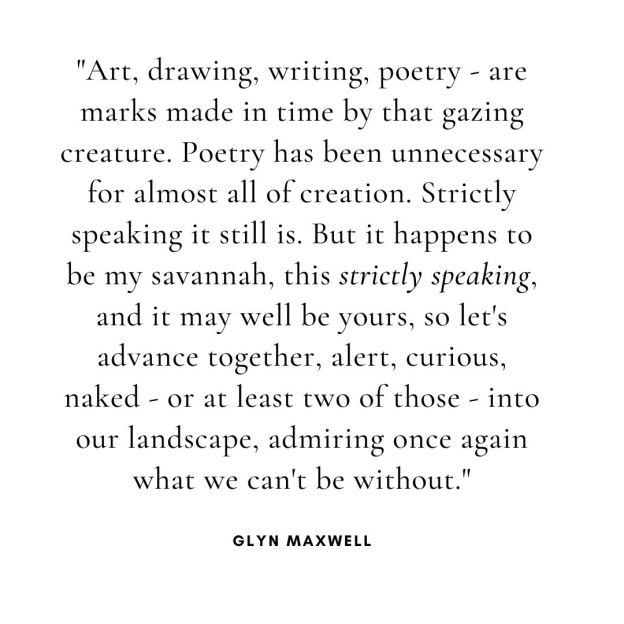
One depiction of this year’s zeitgeist in years to come will be a newsreel of zoom and teams meetings. The newsreel will begin with bumbling communications, a flurry of text messages and emails prior to and for several minutes post the designated start time to mitigate updated links and forgotten appointments. They will feature funny backgrounds, pets, and pyjamas. Perhaps also featuring will be a teenage son in a towel walking by in the background with a coffee – brought to his mother’s attention by the gasps and laughter of her colleagues.  No matter the organisation; a public library, a sports club, a family birthday or Friday night drinks with a friendship group, digital meetings the world over are using the same technologies under the context of a universal experience. We’ve all experienced meetings that leave us with feelings of disconnect but today wasn’t like that for me. Today my colleagues and I were asked to bring our favourite book. A direct invitation to talk books! With my fellow library professionals! Quite the range were in the offerings; books returned to often when wanting a sure thing to get lost in, books that were overwhelmingly nostalgic (that were anything but PC and so drew a laugh), or a signed copy by a favourite author that was found in a secondhand bookstore or had been bought at a writer’s event. Another category that featured was the book that had captured one’s attention in High School. Probably the first book that had an applied reading, where not only the plot was read but where the context in which it was written and the literary mechanics at play were also investigated and appreciated. I have books in all these categories of course but the one I choose to introduce as my favourite today was a non-fiction book, On Poetry (2012) by Glyn Maxwell, published by Oberon Books Ltd. I thought I might share it here too. During my first year of an undergraduate writing degree a teacher, a poet herself, mentioned this ‘small white book’ almost in passing. The mention of it piqued my interest so after the class I immediately sought it out and bought myself a copy. It talks a lot about white space, which is important in poetry, but also in prose. Along with Elizabeth Gilbert’s Ted Talk Your elusive creative genius or a sunny morning on my porch, Maxwell’s On Poetry is an utterly charming go-to when I want to reconnect with my creative self, after any kind of break. Maxwell begins by making poetry accessible. He depicts an image of a savannah 200,000 years ago when homo-sapiens had no language and posits that the scene is the consistent favourite, then and now, over all others, (according to evolutionary psychologists), because we find beauty in what makes life possible and have since the beginning of time. And while we currently might be spending significant periods of time locked up away from our personal versions of a savannah, at least we have our books to remind us of them.

Lounge room travel reflections

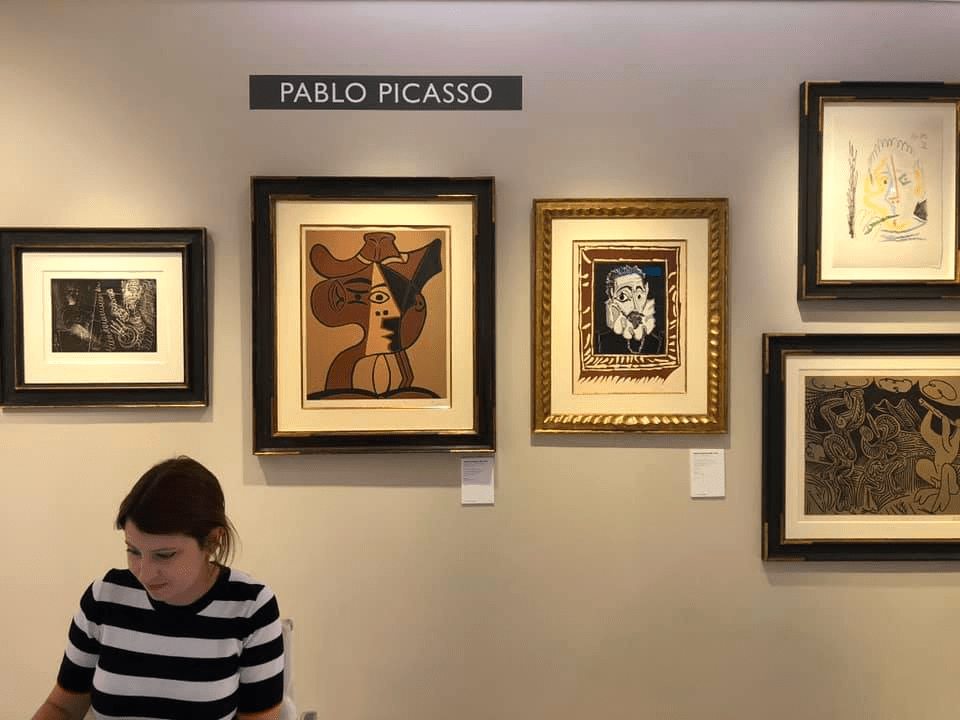
In 2018 I wandered around Harrods by myself in a state of slight panic because I only had about three hours to explore, and I knew immediately it wasn’t going to be near enough time. I seriously could have spent a week there taking photos and soaking it all in. The entrance I used after getting off the underground was green and gold and was not on a through road but at a drop-off point, much like a large hotel. As I arrived at the door, a dark green Bentley pulled up, and several middle eastern women got out. I saw similar groups of women around the store, often holding several shopping bags in each hand. It was quite the spectacle. I saw them again at the Harrods department, where you applied for the purchase tax rebate. My visit wasn’t about shopping bags but consumption by the senses. ‘Shoe Heaven’, decadent staircases, which were completely different in each instance, art books, teapots, Gucci upholstered chairs, and Picasso. Yes, for 135,000 pounds, you could take home a Picasso – on the underground if that was your preferred mode of travel. I spent time in the linen department, which was very white, although I took no photos because I was busy buying cashmere bed socks and pillowcases – you guessed it, in white. I purchased some Chanel makeup and hot pink Christian Louboutin nail polish. The store was quiet, much like an art gallery, except for the tea rooms, the tax department, and the souvenir department.

Chubby mangoes


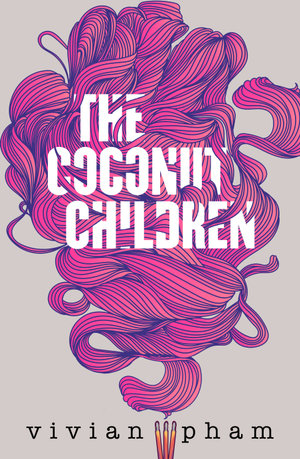
The Coconut Children (2020) published by Vintage (Penguin Random House Australia) amalgamates an intense teen spirit that breaks through intergenerational trauma, lyrical prose, and an incredible human insight that belies the author’s age. Essentially a bildungsroman novel that you won’t find in the YA section of your favourite bookstore or library due to its sophistication. Pham is now just nineteen but was only a teeny sixteen when she penned the first draft. Set in Sydney’s Cabramatta in the late 1990’s the story follows sixteen year old Sonny and her childhood friend Vince as they navigate their journey back to each other after Vince’s two year stint in juvie. Pham’s voice is unique and quite unforgettable. Her mangoes are chubby and her handsome troubled boy drinks sugar cane juice.  It is set firmly in the present as we only get the odd rare glimpse of the past, such is the pain it represents. The story of Sonny and Vince unfolds and takes flight from under the heavy blanket of traumata their parents and their wider community, experienced as Vietnamese refugees. Balancing the trauma is the beauty of the writing and arc, the teenage crush we are introduced to at the beginning and the depth of the real connection that is realised, can only be revered and coveted. Well done Vivian Pham.

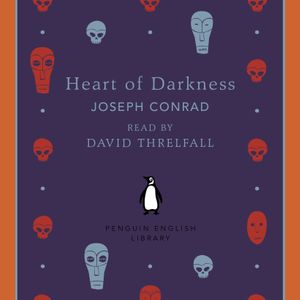
Conrad’s Heart of Darkness embodies the zeitgeist that was the horror of King Leopold’s imperialism.

The astounding gaps in knowledge in our educators are proof that falsehoods invade the historical record like a global pandemic that has been spreading via community transmission for hundreds of years without pause. The order of the day may well be a fictional novel embodying the zeitgeist that was the horror of imperialism in the heart of the Congo in Central Africa so look no further than Joseph Conrad’s Heart of Darkness (1899). I was planning on posting a review on Dark Emu (2014) by Bruce Pascoe (still to come), but I have just read a confessional social media post of a ‘British History teacher’ on a group page for Library Professionals, admitting that she did not know who King Leopold was until just a few days ago. I was shocked, and then I wasn’t. In 1988 in VCE (Year 12) Art History I was taught that the European painters who accompanied the colonialists on tall ships and painted the Australian landscape were not that great (even though they hang in our national galleries) as they overlaid what they saw with their European sensibilities of what a landscape should look like. (Oh how very liberal of our teachers to critique the colonist collaborators). Of course they were capable of painting what they saw! To admit that though is to admit that indigenous people cleared areas of vegetation, and that the landscape vistas that these white artists were privileged beyond words to witness were, wait for it, clearly managed and maintained and done so for reasons beyond their comprehension. (Thank you Bruce Pascoe). Not just an omission in education, but at some point in the past, lies! All lies!

Conrad’s writing is other worldly, intense and short, a mere eighty pages, a novella. Every turn of phrase is worth savouring so if you find it hard work consider doing what I did and retreat to the audio book. Once released from that work, (and the anxiety of several hundred pages of scholarly text that made up the volume and weight in my hands) I was able to properly comprehend Conrad’s phantasmagoric story and appreciate his depiction of the madness of Mr Kurtz, and his journey to get to him (metaphorically and physically), through the eyes of his protagonist, Charles Marlow. Many of you may be more familiar with the film adaption Apocalypse Now (1979) directed by Francis Ford Coppola, (which also garnered critical acclaim) in which the mise en scene is reimagined in Cambodia, and Marlon Brando’s utterance of ‘horror, oh the horror’. The content is horrendous albeit fascinating, and the writing incomparable. If you’re particularly self motivated to self educate this may be the book for you – if not google King Leopold.

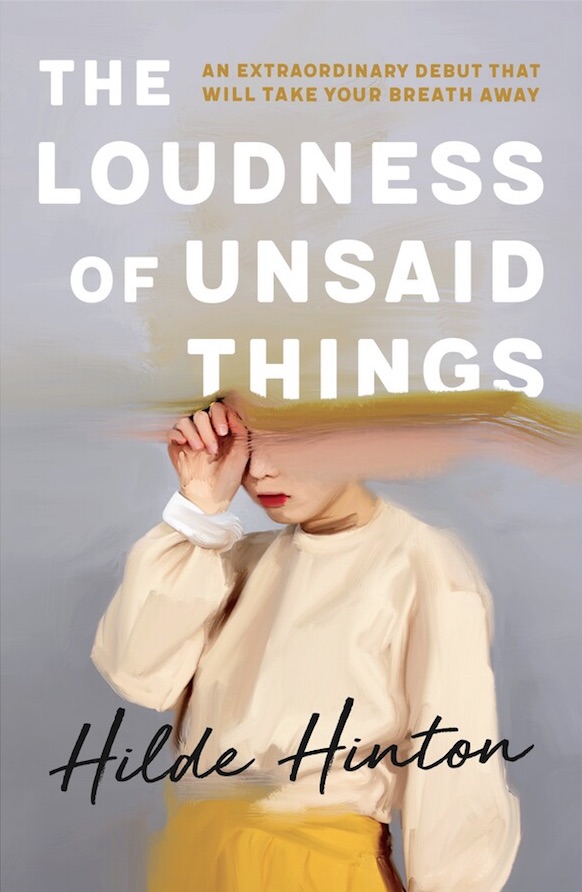
The loudness of unsaid things

In the midst of ISO I was prompted to go online shopping for some new books (in spite of my substantial TBR stack-s) by @louisadeaseyauthor and her blog advice to list ‘comparative titles’ on your book proposal. Knowing that such a beast is a wonderful tool to realise the structure of one’s own manuscript and its place in the great scheme of things, aka the book market I read with interest and quickly translated my first move into ‘I must have new books’. In a few clicks I found The Loudness of Unsaid Things, the debut novel from Hilde Hinton, released in April by @hachetteaustralia. With a fantastic title, and a protagonist that visits her mother within the walls of a ‘mind-hospital’, a theme I know intimately, it was carted without a moments hesitation. Hinton doesn’t disappoint. Her writing is authentic, imaginative, and clever. Her literary device of a secondary narrative is quite brilliant in its ambiguity and its simplicity. There was a small section near the beginning where I fretted for a few pages that we would spend too much time in the protagonist’s juvenile perspective, in spite of the page turning story that was unfolding. I would like to admit to and apologise for my unfounded fears that this book would end up on my half-read pile-s. Hinton’s novel turned out to be a great read and an inspiration to my own writing to boot. I finished it in under twenty-four hours, with tears aplenty. Seriously, there isn’t a writing mode more attuned to getting the feels than a well written fictionalised memoir, and Hinton’s brilliance in this regard is a wonderful homage to empathy – at every opportunity without exception. I went looking and found a story on Hinton, by Jo Abi, published prior to the release. ‘It took her six months to write the first draft, the story of which was based on three pieces of writing she had done years ago that she deemed “the best things I’d ever written” which didn’t tie together well, but she was determined to use them all.’ Oh how the writer’s soul sings when she realises she is not alone!

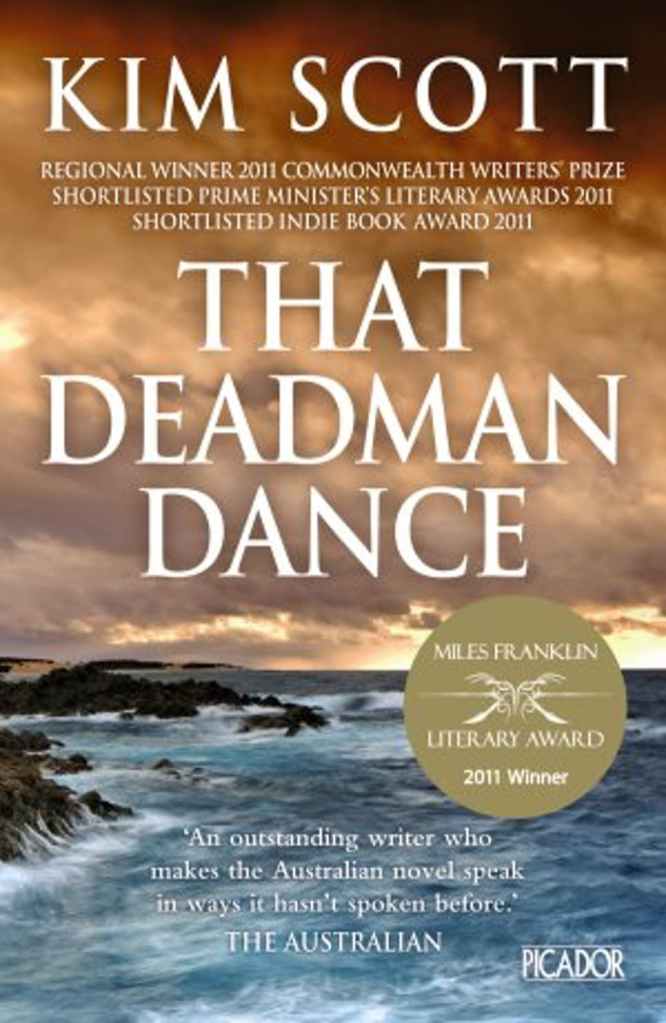
That Deadman Dance

That Deadman Dance (2010) by Kim Scott, a scholar and a descendant of the Noongar people of Western Australia, published by picadoraustralia, won among many awards, the 2011 Miles Franklin award for Literature. I am embarrassed to admit though that had this book not been on the reading list for my Australian Literature unit during my undergraduate degree I might not have ever read it. That Deadman Dance is an exquisite reimagining of a first contact story told through both a white and an indigenous perspective and asks some big questions through the detailed creative showing (and not didactically) of what transpired. Scott depicts the gamut of human character in both races and leaves the reader with an overwhelming sense and a better understanding of the missed opportunities of our past. The heartbreaking glimpse of what could have been has stayed with me, years after the first reading. “We learned your words and songs and stories and never knew you didn’t want to hear ours.” As readers we can choose what we read with consideration, we can choose with a willingness to listen to perspectives that are different to our own lived experience. What we read is an integral path to learning from the past so we can do better tomorrow.

A message from a mother: a reformed skeptic of the newly installed highway barriers, written in the third person because it was only yesterday

It was the first day of winter and a Saturday. The weather had turned sharply a week before and there had been constant rain for a week. Her son fell asleep at the wheel at 5.30am on the way to work. He had put his hand up for overtime. He is a good boy; a nineteen-year-old Diesel Technician apprentice. Usually, when someone falls asleep at the wheel the pressure on the accelerator pedal reduces. Still, it doesn’t usually end well. There’s always a tree, or an embankment, or another car. Her son was on the Western Highway at the speed limit of 110km per hour. He woke up when all four tyres hit the dirt. His tyre tracks ran through the new grass and then his car slammed into the newly installed barriers. His car spun out across the highway enough times to give him time to articulate the thought he was going to die. His mother is at once dizzy at that thought and then her heart cracks wide open as she puts herself in his experience.  He slammed into the barrier again, taking out another six or more posts but the wire held firm. The wire saved his life. His own car was in the shop so he was driving a very old ute that his Pop had bought for a runaround. The roadworthy had stipulated new seat belts so they had been replaced. The car was towed straight to the wreckers but he walked away without a scratch. Police attending another accident where a car had hit a pole on an adjacent road watched the whole episode unravel and walked over to comfort him immediately. It still feels like the worst day of her life. If the wire wasn’t there he would have sped down the small, sludgy embankment and most certainly would have flipped his car and most certainly died.

The Mothers cracked heart is only holding together with strings of constant tears and a new appreciation of what it is to be anxious. A state too filled with too much of everything.  She is grateful for the wire but her experience needs to be filled quickly with new hellos and goodbyes and more hellos so her son telling her I thought I was going to die becomes a distant troublesome memory. Is that even possible? She woke this morning at 4am wanting to wake her son to check he hadn’t bled to death internally overnight. Irrational but compelling. It reminds her of when he was a baby and if she woke in the night she would check for his breath. The universe guides her but it’s Sunday and she wants him to rest so she resists for a few hours. Is resisting strength or a deviation to remaining true to who she was before? This is now the mother’s anxiety. At least in the quiet hours on the road, when sleep is the enemy, she can be comforted that the barriers will guide the way.

Explaining the Heaven

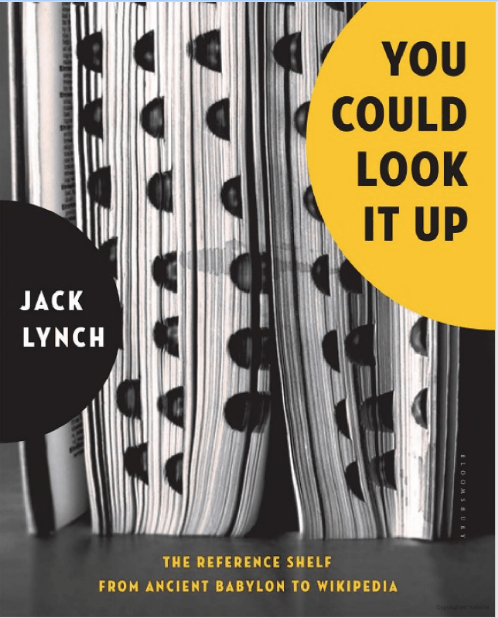
Occasionally, if we are lucky during our bibliographical exploratory journey the universe may drop into our laps an extraordinary gem. Books which blow us a little closer to the stars.  I am currently reading Jack Lynch’s You Could Look it Up (2016) published by Bloomsbury Press, which explores ‘The reference shelf from ancient Babylon to Wikipedia’. It sounds rather like a infinite uninhabited desert, full of dusty relics but it’s not. The structure of Lynch’s book is attention grabbing and bursting with humanity from the get go. He groups together two carefully selected reference ‘books’ in each of the twenty-four chapters, (in the process of discarding a good number of equally fascinating ones by his own admission) with a ‘half’ chapter between each. These half chapters explore themes such as ‘The Dictionary Gets its day in Court’, and ‘Ignorance, Pure Ignorance: Of Omissions, Ambiguities, and Plain Old Blunders.’ Some of the ‘books’ featured are in fact volumes of tablets depicting ancient laws (as brutal as you can imagine) and dictionaries or simply lists of words. Chapter twenty is ‘Modern Materia Medica’, where Henry Gray and Henry Vandyke Carter’s Anatomy Descriptive and Surgical (1858), aka Gray’s Anatomy (no it is not just a television show) and the Diagnostic and Statistical Manual of Mental Disorders (1952) appear together. It is followed by chapter twenty and a half; ‘Incomplete and Abandoned Projects’, which begins with, ‘In the back alleys of intellectual history are scattered the abandoned wrecks of would-be dictionaries and encyclopedias.’ I find myself compelled to share that never before has a non-fiction book driven me to bed at such an early hour for the sole purpose of reading, or to spontaneously write an unsolicited review in the wee hours. I am usually decidedly more inclined to fall asleep reading fiction or memoir.

What Lynch also offers is some shooting stars, some extra special words pulled back from long ago to make us weep from the sheer beauty of them. In chapter two ‘In the beginning was the word; The first dictionaries’, Lynch gives us Erya an ancient Chinese dictionary that dates back (unconfirmed) to around third century B.C.E.

Poetry or dictionary? You decide:

Explaining the Heaven

‘Round hollow and very blue, this is Heaven. In springtime, Heaven is blue; in summertime, bright; in autumn, clear, in wintertime, Heaven is wide up. These are the four seasons. In springtime, there is a greening sun-warmth; in summer, a reddish enlightening; in autumn a blank storing; and in winter a dark blossom. If all these expressions are harmonious, (the year) is called “jade candle.” The spring gives birth; the autumn grows the adult; in autumn the harvest is completed; and in winter there is a peaceful tranquility. If the harmony of the four seasons is thorough and correct, (the year) is called “illustrious wind.” If the sweet rain comes down to the right time, the many things are at their best, it is called “sweet spring.” This means luck.’

Luck it would seem is not so random and neither are great books. Heaven surrounds us; in the tendered garden and in our changing seasons, and from one bibliophile to any other, and on the reference shelf.